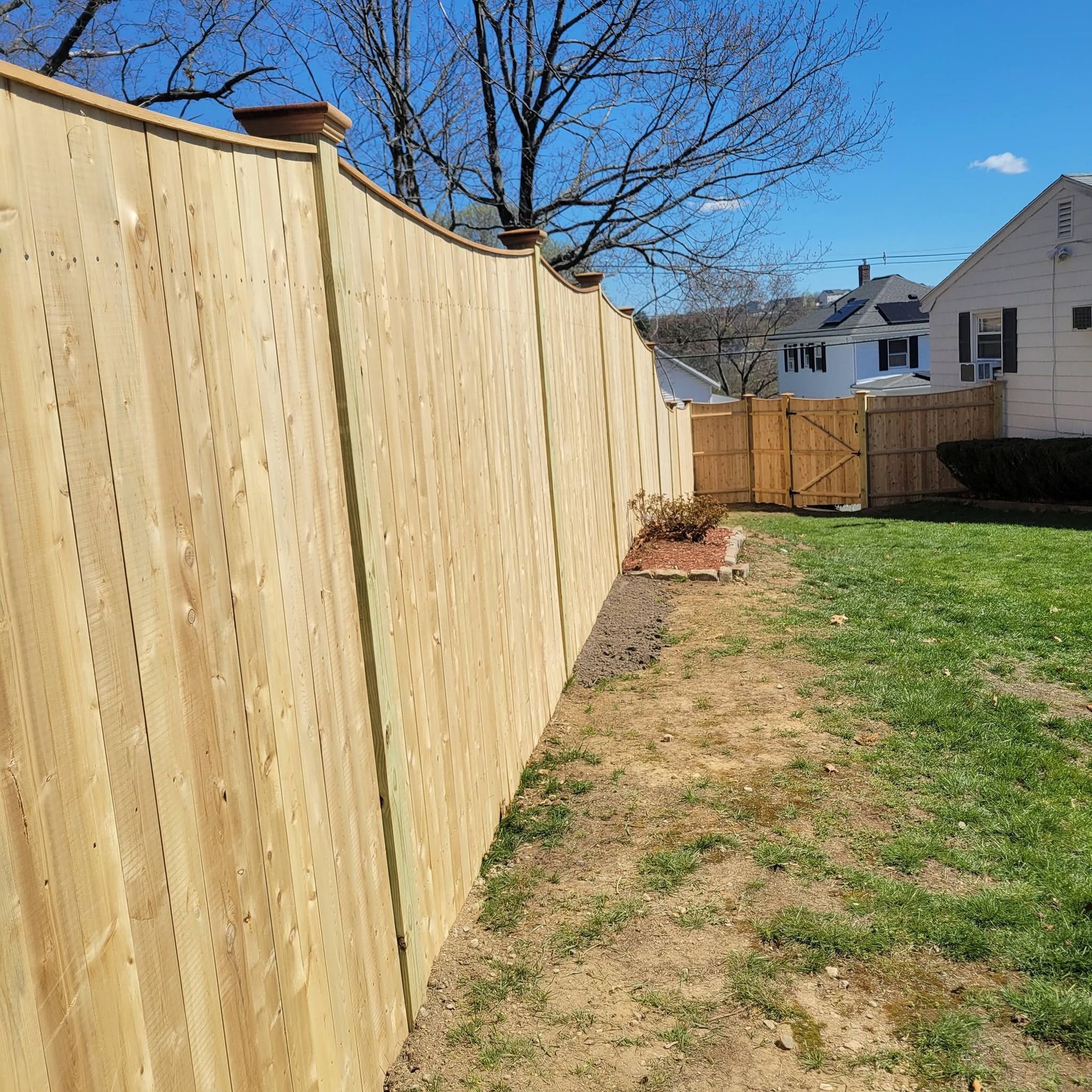
Wood Fence Turning Gray or Starting to Warp? What New England Weather Is Doing to Your Boards
Quick Answer: A cedar or pressure-treated fence starts turning silvery gray within six to twelve months of installation because ultraviolet light breaks down lignin, the compound that binds and colors wood fibers — it's a surface change, not decay. Warping, cupping, or bowing happens when one face of a board absorbs or releases moisture faster than the other, and that swing happens more often on the North Shore, where coastal humidity, salt-laden air, and hard winter freeze-thaw cycles push boards through repeated swelling and shrinking all year. Graying by itself is cosmetic and reversible with cleaning and a fresh coat of stain or sealer. Warping that goes past a slight cup, paired with soft spots, cracked rails, or a section pulling away from its posts, points to moisture working into the wood fibers themselves, and that usually means a board needs replacing rather than resealing.
Two summers after you put up a cedar privacy fence, the honey-brown boards you picked out at install start looking more like driftwood. A few rails on the side that catches the most wind off the water begin showing a faint cup, where the top edge pulls slightly away from the face. None of that means the crew who built it did anything wrong. It's just what wood does outdoors, and it happens faster in a place where salt spray, nor'easters, and hard freezes are part of the yearly rhythm. Knowing what's cosmetic and what's structural keeps you from ignoring a problem that's actually getting worse — or tearing out boards that only needed a wash and a coat of sealer.
Why Every Wood Fence Turns Gray Eventually
The Chemistry Behind It
Wood owes its color to lignin, the natural compound that binds cellulose fibers together and gives fresh-cut cedar and pine their warm tone. Sunlight — specifically ultraviolet radiation — breaks that lignin down at the surface. As the degraded lignin washes away with rain and dew, the exposed cellulose fibers are left behind, and they reflect light as a silvery gray rather than the original brown or reddish tan. Research reviewing decades of wood-weathering studies describes this as a surface effect: the outer layer changes color and texture while the wood underneath stays sound, at least at first.
How Fast It Happens
Most fences show visible graying within six to twelve months of going up, and the process rarely stops — it just slows once the surface layer has fully weathered. Darker fungal staining often follows the initial color change, since the roughened, UV-damaged surface holds moisture longer and gives mold and mildew spores something to grip. That combination is why an unfinished fence can look closer to charcoal gray than silver after a couple of New England winters.
None of it, on its own, means the boards are failing. It's cosmetic, not structural — worth remembering before you assume a graying fence needs to be torn out.
Coastal Salt Air Adds Another Layer
Fences close to the water, or exposed to salt spray carried inland on winter storms, weather faster than the same wood would inland. Salt is hygroscopic — it pulls moisture out of the air and holds it against whatever surface it lands on, which keeps fence boards damper for longer stretches than a dry inland yard would see. That extra moisture accelerates both the surface graying process and the fungal staining that follows it, and it also speeds up corrosion on any exposed nails, screws, or hinge hardware. Homeowners along the North Shore, from Saugus out toward Lynn and the harbor towns, often notice their fences gray and streak faster on the side facing the water than on the side facing the street, which lines up with how salt exposure and prevailing wind direction actually work.
What's Really Happening When a Board Warps, Cups, or Bows
Cupping, Bowing, And Twisting Aren't The Same Problem
A board that cups curls along its width, so the edges lift while the center stays flat — that's the most common warp on fence pickets. A board that bows curves along its length instead. Twisting is a corkscrew shape that shows up when a board's grain runs at an angle to its length. All three trace back to the same root cause: wood shrinks and swells as its moisture content changes, and it doesn't shrink or swell evenly in every direction. That's just physics, not a defect in the board. According to wood-science research from university extension programs, wood moves roughly twice as much across the grain in the tangential direction as it does in the radial direction, and almost not at all along its length. When one face of a board dries faster than the other — because it's catching more sun, more wind, or more direct rain — that mismatch in movement is what pulls the board out of flat.
Why The Sunny Side Moves More
A picket mounted with the bark side facing out tends to cup toward the bark side as it dries, because of how the growth rings curve within the board. Add a fence line where one face gets baked by afternoon sun while the other stays shaded and damp, and you've got the exact mismatch that produces a visible cup within a season or two. This is also why boards on the ocean-facing side of a property often show warping before boards on a more sheltered side of the same fence.
Tip: Clean grayed boards with a soft-bristle brush and a wood-safe cleaner rather than a pressure washer. High-pressure water forces itself into the grain and raises the fibers, which leaves more surface area exposed to sun and moisture — the opposite of what you want if the goal is to slow down warping along with the graying.
Freeze-Thaw Cycles Compound the Movement
New England winters add a mechanical stress on top of the moisture-driven one. Water that's worked its way into small checks and cracks in a board's surface expands roughly nine percent when it freezes. That expansion widens existing cracks and can pry apart joints where a picket meets a rail, especially on boards that have already lost some surface integrity to UV exposure. A hard freeze followed by a thaw, followed by another freeze — which is a normal week in a North Shore January — repeats that stress cycle over and over across a single winter. Posts aren't immune either: frost heave from ground freezing can shift a post slightly out of plumb, which throws off the alignment of the boards attached to it and can look like warping even when the boards themselves are fine.
But that doesn't mean a wood fence can't handle a Massachusetts winter. It's routinely done, and reinforced posts set below the frost line are built for exactly this kind of seasonal movement. What it does mean is that a fence going into its second or third winter benefits from a maintenance check before the cold sets in, since small cracks are far easier to seal in October than to repair after a winter of freeze-thaw cycles has widened them.
Care Steps That Slow Down Both Graying and Warping
Reseal On A Schedule, Not Just When It Looks Bad
A film-forming stain or a penetrating sealer both block UV light and slow moisture movement, but neither lasts forever. In a coastal New England climate, most cedar and pressure-treated fences need a fresh coat of sealer or stain roughly every one to two years, sooner on sections that face the most sun and salt spray. Waiting until the wood already looks silver-gray means the surface fibers have already degraded, so cleaning before that reapplication matters as much as the product itself.
Manage Water Around The Fence Line, Not Just On It
Downspouts, sprinkler heads, and low spots that drain toward a fence keep boards wetter than their neighbors, which is exactly the uneven-moisture situation that produces warping. Redirecting a downspout or regrading a low spot a few feet away from the fence line does more for warp prevention than any sealant can.
Keep Air Moving Around The Boards
Vegetation growing tight against a fence traps humidity against the wood and slows drying after rain, which speeds up both graying and fungal staining. A gap of even a few inches between shrubs and the fence line lets boards dry evenly on both faces.
Watch Board Orientation On Repairs
When a picket gets replaced, the way it's installed affects how it ages. Boards oriented with consistent grain direction across a section weather more evenly than a mismatched patch job, which is one reason a professional wood fence installation accounts for board orientation up front rather than treating it as an afterthought.
When Graying or Warping Means More Than a Cosmetic Fix
Cosmetic Signs
Even, all-over graying with no soft spots, a slight cup on a handful of boards, and dark streaking that wipes away with cleaning are all typical weathering. These respond to cleaning and refinishing.
Structural Signs
A board that flexes noticeably when pushed, feels spongy, or crumbles under light pressure has decay working past the surface layer — that's a different problem than UV graying, and cleaning or sealing won't fix it. Fasteners pulling loose from softened wood, a section separating from its rail, or a post that rocks in the ground are all signs that isolated repair, or in some cases a section replacement, is the right call before the problem spreads to healthy boards nearby.
Warning: If a board feels soft or a screwdriver tip sinks into it with light pressure, that's decay, not weathering — leaving it in place lets moisture and rot spread to the boards and rail around it. Replacing that one board early is a far smaller job than rebuilding a whole section after the damage travels.
Frequently Asked Questions
Does a gray fence mean it's rotting?
No. Gray coloring results from UV exposure breaking down lignin at the wood's surface. Rot is different, involving fungal decay that softens the wood. Sound boards resist pressure, while decayed wood feels noticeably soft or spongy.
Can graying be reversed once it happens?
Yes. Cleaning removes surface weathering and staining can restore the wood's color while providing UV and moisture protection. Severely weathered boards may benefit from light sanding before refinishing, creating a smoother surface for the new coating.
How often should a wood fence be resealed in a coastal Massachusetts climate?
Most coastal Massachusetts wood fences benefit from resealing every one to two years. Sections exposed to strong sunlight, moisture, and salt air may need attention sooner, while sheltered areas can sometimes go longer between treatments.
Does cedar warp less than pressure-treated pine?
Generally, cedar is more dimensionally stable because of its grain and natural properties. Pressure-treated pine can move more as it dries after installation. However, both woods can warp when exposed to uneven moisture, sunlight, and seasonal changes.
Can a warped board be fixed without replacing the whole fence?
Usually, yes. A single warped picket can often be replaced without disturbing the entire fence, provided the surrounding rails and posts remain sound. Extensive warping, soft wood, or multiple damaged boards may require section replacement.
Does staining prevent warping, or only graying?
Staining helps slow both graying and warping. UV protection reduces surface degradation, while moisture resistance limits repeated swelling and shrinking. Although staining cannot eliminate natural wood movement, regular maintenance can significantly reduce weather-related changes over time.
What New England Weather Means for Wood Fences
A wood fence naturally changes as it weathers, and New England's coastal conditions can make those changes more noticeable. In Saugus, seasonal sun, humidity, salt-laden air, rain, and repeated freeze-thaw cycles all contribute to the gradual graying and movement of cedar and pressure-treated boards. Understanding the difference between normal weathering and actual deterioration makes it easier to know when a fence simply needs cleaning and refinishing and when a damaged board or section needs attention.
For homeowners in Saugus, MA, Mass Fence, LLC
brings 10
years of fencing experience to
wood fence
installation, repair, and maintenance. The right care can help preserve the appearance and performance of a fence through many New England seasons. A consistent approach to cleaning, sealing, drainage, and early repairs can keep minor surface changes from becoming larger problems as the years go by.